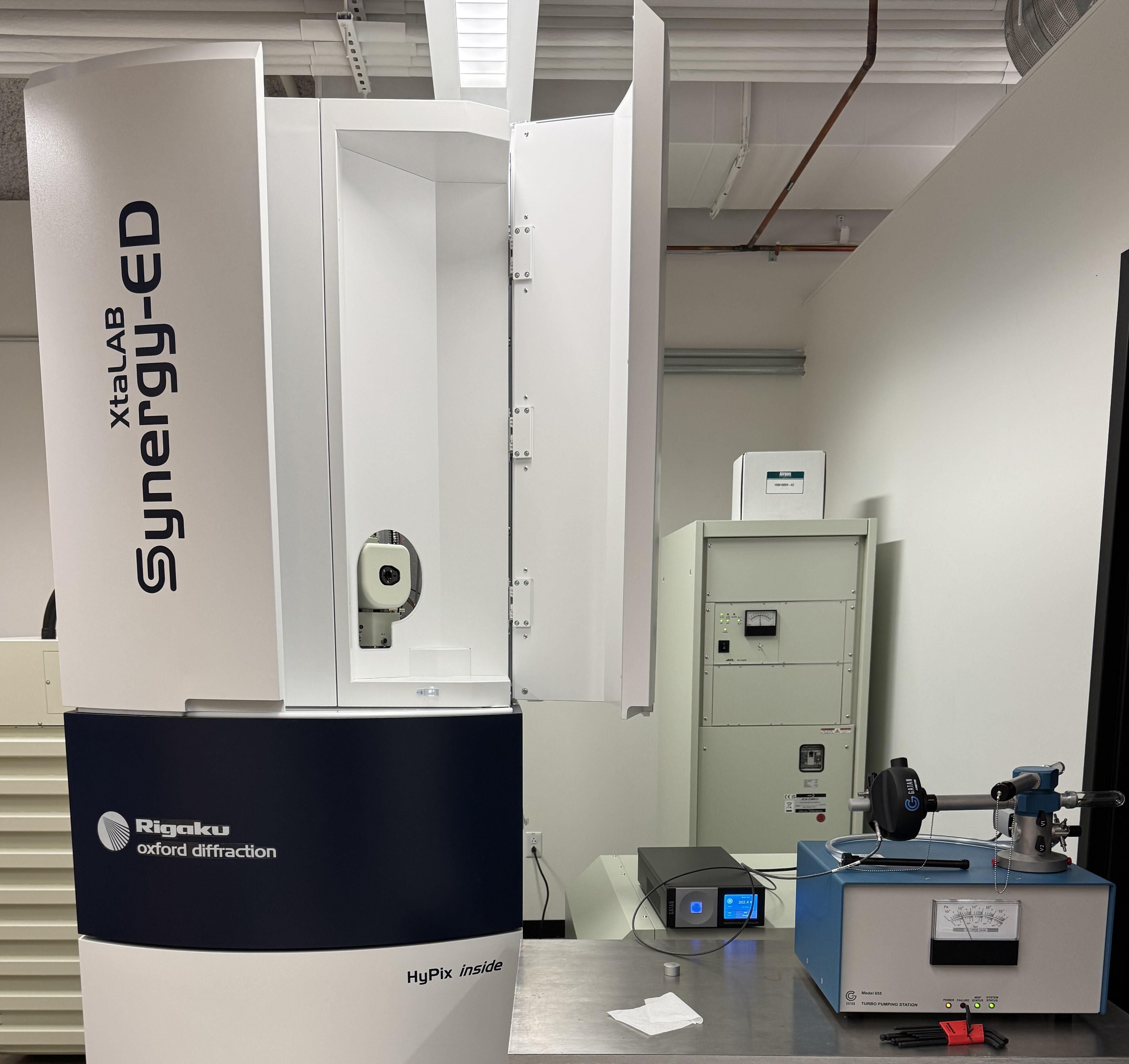
Short Name:
Synergy-ED
Instrument Type:
Diffraction (X-ray and electron)
Imaging
Scattering
Structural Science
Location:
KCL 7
Date of Acquisition:
January 2025
Description:
The Synergy-ED is a state-of-the-art electron diffractometer designed for Microcrystal Electron Diffraction (MicroED) / 3D Electron Diffraction (3DED) experiments. It enables high-resolution structural analysis of nanocrystalline materials that are too small for conventional X-ray diffraction techniques.
Key Features
Wavelength:
Operates at an electron wavelength of ~0.0251 Å with a 200 kV accelerating voltage, providing high-resolution diffraction data.
Temperature Range:
Capable of measuring samples from room temperature down to 100 K, allowing for studies of temperature-dependent structural changes.
Viable Grain Size:
Suitable for nanocrystals and microcrystals ranging from several hundred nanometers to less than 10 microns.
Sample Types
The Synergy-ED is optimized for a broad range of crystalline materials, including:
- Small organic molecules (e.g., pharmaceuticals, natural products)
- Inorganic nanomaterials
- Metal-organic frameworks (MOFs) and zeolites
- Peptides and small proteins
- Polymers and hybrid materials
Applications
The Synergy-ED provides critical structural insights across multiple fields, including:
Pharmaceutical Research:
- Polymorph Studies: Determines different crystal forms of a compound, crucial for drug formulation and stability.
- Phase Transitions: Investigates temperature- or pressure-induced structural changes.
Materials Science & Nanotechnology:
- Grain Boundary Analysis: Characterizes defects, interfaces, and grain orientations in polycrystalline materials.
- Nanocrystalline and Amorphous Phase Identification: Helps differentiate between ordered and disordered structures.
Heterogeneous Sample Analysis:
- Sample Mixtures: Can resolve and identify multiple crystalline phases within complex mixtures.
- Solid-State Chemistry: Provides insight into phase purity and composition.
Instrument Image: